Tethering a Canon Camera over USB
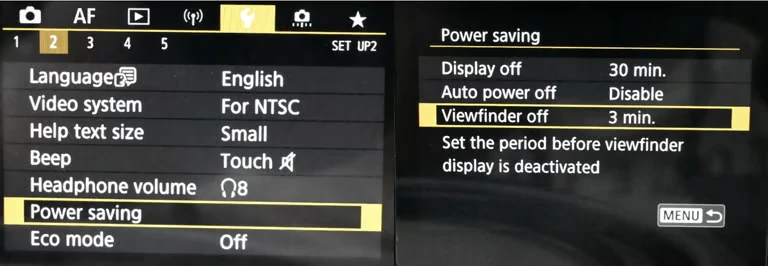
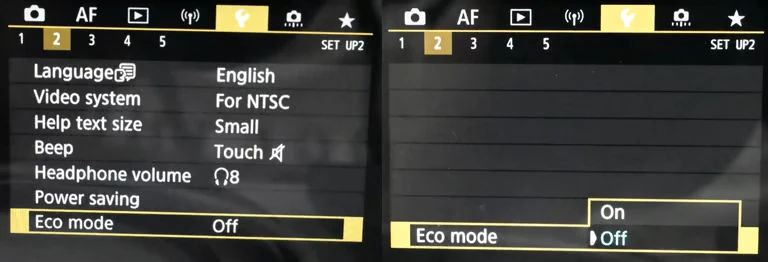
With Canon, sorting out power saving usually gets you there. Menu names and locations vary a lot between models, though, so the same item may go by another name.
What you need
A USB-C (OTG) cable, an Android phone and your camera. The camera end is either USB-C or micro USB depending on the model.
Charge-only cables have no data wires. They look identical, but nothing at all happens when you plug one in. Use the cable that came with the camera, or one that says it carries data.
Without a card the camera either refuses the connection outright or will not take shooting commands. Keep one inserted even if you only intend to receive photos on the phone.
Connecting
Three steps. Only the first happens on the camera, the rest on the phone.
Turn off the camera power saving
Whatever the brand, this is the most common cause of dropouts. Even with the cable in, the camera falls asleep on its own when left alone, and the connection goes with it. Turn it back on after the shoot.
Deal with power saving and eco mode together in the setup menu. They sit in two separate places.
Change the USB settings
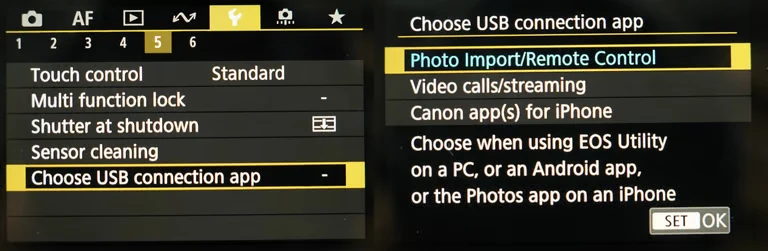
Video calls and streaming is for webcam use, and Canon apps for iPhone is exactly that. The camera's own on-screen help says this setting is what an Android app uses, so pick the first one with confidence. Older bodies do not have this item at all, in which case there is nothing to choose and turning power saving off is enough.
Plug the cable in
With the camera switched on, join the camera and the phone with the cable. The order does not matter.
Adapters and USB hubs often break detection. Joining the camera and the phone with a single cable is the reliable way.
Allow the permission on the phone
As soon as the cable is in, a dialog asks whether to let CamCon access this camera. Tap allow and it is recognised right away, ready to shoot.
Allow CamCon to access this camera? [ ] Always use for this camera
Photos land on your phone the moment you press the shutter. If a film simulation is on, they arrive with the look already applied. Live view and shooting settings can be controlled from the phone as well.
Some cameras block card access while under remote control. On those, switch the USB setting to MTP to browse the card. Remote shooting will not work in that state, so it is one or the other.
If it does not connect
Work down the list in order. The first three solve most cases.
-
Is it a charge-only cable?
If no permission dialog appears at all, this is almost always why. Try a different cable. The one that came with the camera is the safest bet.
-
Is the USB setting on mass storage?
If the app reports a USB I/O error, this is the setting. Go back to the first step and switch it to PTP or PC connection.
-
You tapped allow but it says denied?
On some phones, tapping allow still comes through as denied. The app double checks and corrects for this, but if it persists, unplug the cable and plug it back in.
-
Are you going through an adapter or hub?
Anything in the middle can pass power while cutting data. Try a single direct cable, and if that works, the adapter was the cause.
-
Has the camera gone to sleep?
Left plugged in for a while, the camera switches itself off. Half press the shutter to wake it, then tap refresh in the app.
-
Does your phone support OTG?
Most modern phones do, but some budget models cannot see external devices at all. A quick check is to plug in a USB stick and see whether it is recognised.
-
Is the camera firmware out of date?
USB behaviour has been fixed by firmware updates more than once. If everything above fails, check the maker site for the latest firmware.
If you would rather go wireless
Wireless takes different settings on each brand, but once it is set up you can shoot without a cable. There is a guide for each brand.
Canon Wi-Fi